
Today’s piece by Jack tells the story of a life in Greater Manchester you might otherwise never have heard about — that of Paul Jackson, a homeless man who died this week in Withington.
It’s a type of journalism we think can be just as important as the big investigations into Abu Dhabi ownership of the city centre or scandals at the University of Greater Manchester, because it helps you to better understand and connect with the people and places around you.
You might remember previous examples of this kind of journalism, like Dani Cole writing about her search for answers about a lonely burial in south Manchester back in 2022, or Joshi’s piece about a quiet life lived by a man called Martin on an estate in White Moss. Both of those stories, and this one, are free to read for anyone who comes across them — as is half of the work we put out.
We hope you find value in this one as we know readers did in the others. If you would like to sign up as a paid member and support our work though, joining the 3,500-odd Millers who fund all of our work and make it possible for us to do this kind of journalism, you can do so for £1.70 a week with the button below.
On Monday morning Paul Jackson, a homeless man in his early 50s from Beswick, stepped into the Costa Coffee in Withington with his best friend Kyle. Neither of them spoke much, though Paul never did. A broad man with a beard and a rare kindness, he would — despite his own situation — tip the baristas. And though he was quiet, subdued and usually drunk, he was aware of his surroundings. Often, he’d make observations or ask questions about things people thought beyond his notice. But that morning, he and Kyle sat near the window charging their phones and watching the rain. Paul slept.
The Withington Costa is an assembly point for the area’s homeless and vulnerable. There is Sharon, who has been homeless nine years and has lived everywhere from council accommodation to the streets, to friends' sofas and to a greenhouse behind a church. Then Sharon’s friend Steve, who speaks in flowing monologues to no one in particular and wears socks layered on top of each other instead of shoes. There’s Andrew, an epileptic man with hypersensitivity who wears big headphones and sits and draws for five hours or so a day with a coffee. And looping around outside on old bicycles are two men I never get the names of, but who will tell you whatever you want to know so long as you let them use your phone to make a call. There is also Louis, who we’ll get back to.
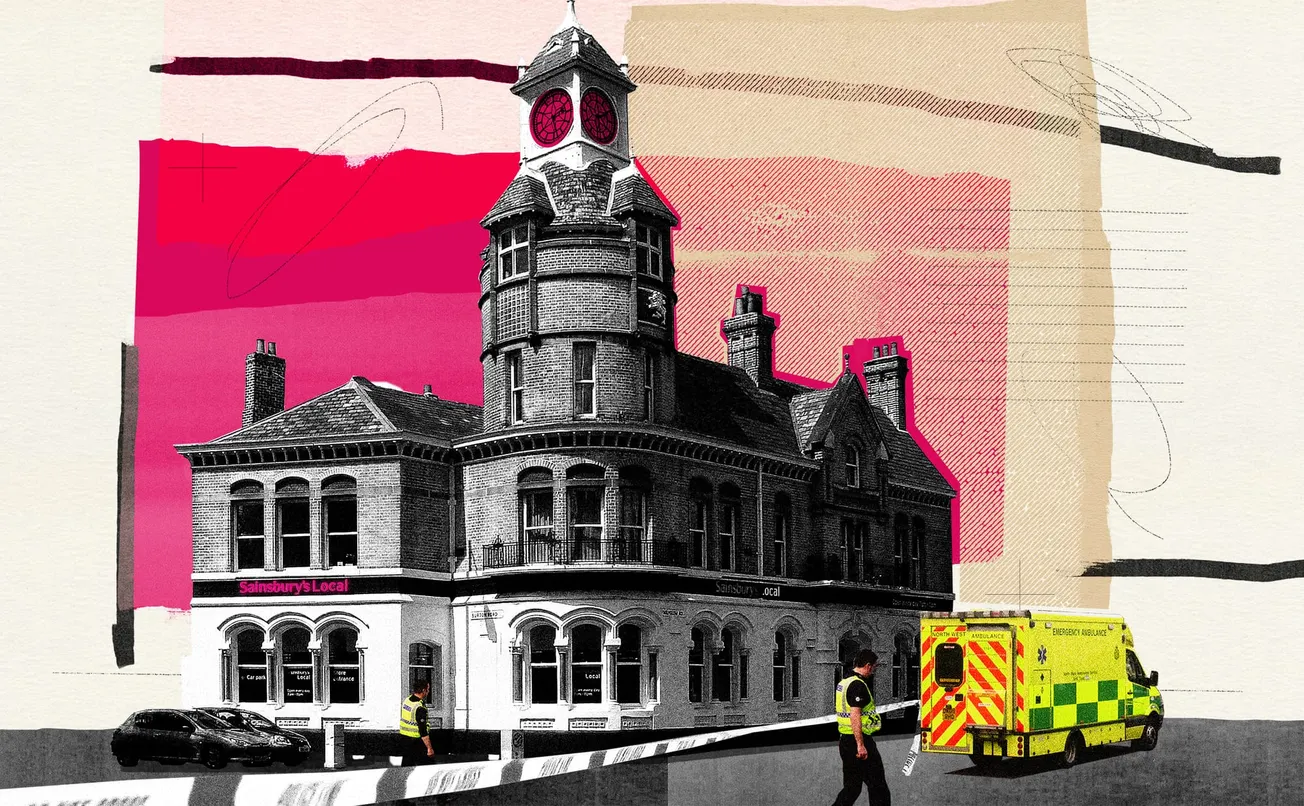
After sleeping that morning, Paul went to stand outside the Sainsbury’s Local, where he had become something of a fixture. Him outside the Sainsbury’s, Kyle outside the Co-op around the corner. Kyle is much younger than Paul. Though he never tells me, I expect he’s younger than thirty, with a heavy flop of hair over his forehead and clear eyes.
Paul stood outside the Sainsbury’s for most of that long rainy Monday, during which time Sharon saw him and said hello, and another man on a bicycle gave him the remains of a cigarette. “He was just standing up, trying to get a few quid,” Sharon remembers.
The rain got harder in the early afternoon and the Costa was so quiet the staff started clearing things away early. Paul was joined by a short man with jet black hair and boyish energy: Louis. Sharon was sat outside the Costa and Kyle was back up outside the Co-op. A little after 3:30pm Louis left Paul to go carry out some task or other, but as he returned he saw Paul slumped on the ground.
He had been there for about ten minutes before Louis and others reached him. His skin had turned blue. Sharon saw Louis run past the coffee shop and watched on. Someone went to get Kyle and he ran down the precinct to what had become a frenzy. A woman burst into the Costa screaming for a defibrillator and Kyle fought his way through the crowd to get to Paul, who members of the public were giving CPR. He wanted to hug him, but he was pulled away.
The ambulance arrived. An onlooker who spoke to me afterwards said that, watching the crowd around Paul’s body, they thought that someone had been attacked. The rain had begun to die down by the time the ambulance crew began work. Bystanders told one another the homeless man had “just died”. I understand Paul wasn’t actually declared dead — apparently as a result of a cardiac arrest — until he reached Manchester Royal Infirmary.
That same afternoon I arrive. A cordon is being taken down from around the scene and I find Sharon beneath the awning of the Costa as the police cars drive away, throwing blue and red lights off the puddles in the road and through the windows of the cafes back towards town. The staff are starting to pull the chairs in. A man pulls up on a bicycle and lights a cigarette and Sharon knows him.
“He’s a journalist asking about Paul,” Sharon says, her arm thrown over the back of the chair like she is about to reverse. “You know he just died?” The man replies: “You’re joking? I just gave him a cig this morning.”
Usually, when asked to write about a death, the better-worn path for a journalist is to speak to the neighbours. But Paul didn’t have any. He lived in a small community of drifters, sometimes in hostels and council accommodation, sometimes on the street. The tragedy of any rough sleeper’s death is how quickly it can be forgotten, or barely known about in the first place. Paul’s death didn’t make the news. Obituarists went unsummoned. No family members were interviewed to tell us who he was. As far as I’m aware, his body is still unclaimed in the hospital mortuary.
It was largely for this reason that I set about finding whatever I could about him. I walked around asking after Louis, and speaking to Sharon and her friends, but it was Kyle who I suspected would be able to tell me most. I let the two guys riding bicycles around use my phone to make a call on the condition they’d show me where Kyle was. I dialled the number and the three of us stood listening to it ringing on speaker until it went to voicemail. Keeping their end of the bargain, they turned and pointed. Kyle was sitting behind me.
“I don’t want to talk about the death of my best friend,” he says grimly. They met at Rams Lodge, an old hotel in Fallowfield repurposed as emergency accommodation under the A Bed Every Night scheme, a year ago. The building is ramshackle and much has been written about its conditions that I won’t go into. When I visited to ask if anyone was aware of Paul’s death I was told, under GDPR, they couldn’t disclose who was living there. Though on a whiteboard in the back office a Paul is listed as living on the second floor, it’s not possible to tell whether that was referring to the Paul I was looking for.
Both Kyle and Paul were in and out of Rams Lodge and other hostels. “We went and lived at the airport for a bit,” Kyle tells me. Paul’s most recent ejection from Rams Lodge was apparently because he was drinking on the premises, “but he needed it”, Kyle says. Paul was dependent on alcohol, and I’m told by his friends he had been accepted into a detox clinic this month. Paul had big plans for when that was done. “As soon as he was accepted into detox he wanted to get out fat,” Kyle says, referring to Paul regaining weight. “Then he wanted to get a passport and go to Spain.” He says. “He had dreams. But like proper, achievable ones.”
Paul told Kyle he had no family, and even as a close friend he wasn’t sure of what life Paul had before he became homeless. Sharon had only known him a few months, but said Paul was generous and kind. People working in the shops around the precinct remember him as another feature of the landscape.
During the last week I have been wandering around Withington speaking to people about Paul or otherwise emailing public bodies and charities about him, or consulting Facebook videos and other bits of social media for a sign of him. The immediate process put into place when a homeless person dies on the street is no different to anyone else without next of kin or a set address. The point of difference is that in Paul’s case his death may spark a Safeguarding Adults Review, run by the Manchester Safeguarding Partnership. But when I email to ask about Paul and to arrange an interview, I get no reply. The coroner may also be more likely to investigate Paul’s death, though when I get in touch with the office no one is available to interview due to staff shortages.
It is easy to boil the life of a homeless person down to the pursuit of warmth, food and safety. But to do so belies the community and camaraderie — even belonging — that a life on the street can entail. This isn’t to glorify it, but there is much to a homeless person’s life beyond those base metals. There's longer-term ambitions, creative ambitions, life ambitions. It’s a shame it takes one to die for us to bother to learn about it. “No one wanted to do anything for him,” Kyle tells me, a reporter deciding to take interest now, pointedly. “Now he’s dead, everyone wants to do everything for him.”
Yesterday morning I was back in the Costa waiting for a drink when Louis walked in. He took long strides up to me like we were already acquainted.
“I’ve been looking for you,” I said.
“Yeah I know you have. Listen, my sister and her nephew are outside and I need to sort things with my family, like, now. But then let’s talk.”
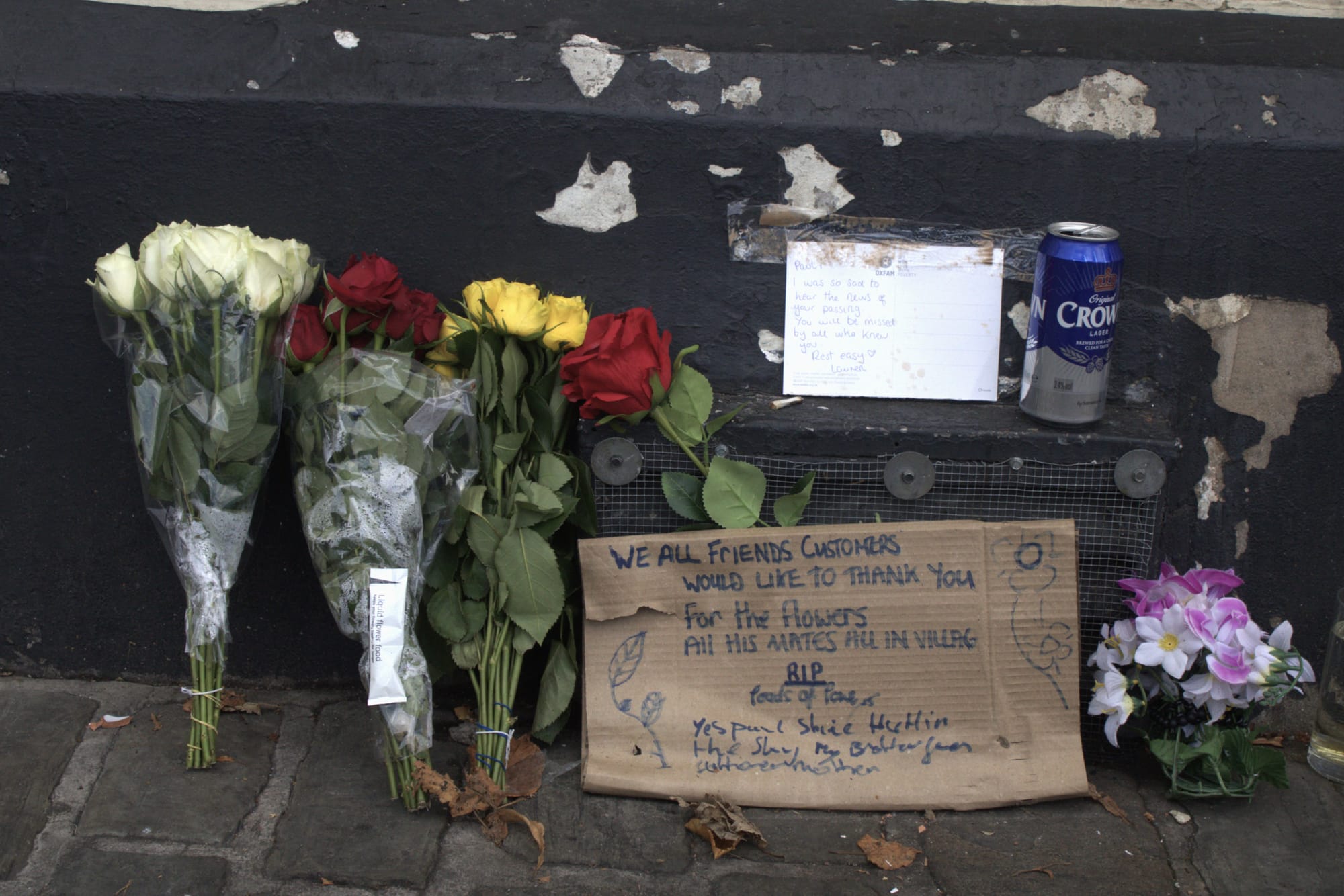
Louis got some water and took it to the flowers that had been left for Paul by his friends and some regular customers and poured the water on them. Then I joined him, his sister, nephew and presumably his sister’s partner up Wilmslow Road. They, too, had been looking for Louis. Then a police van appeared and the partner got into an argument with an officer. Louis told me to meet him at the back of the library and split on a bike. Then when I got to the library I could only see him still pedalling away. I went back to Costa.
As such, I was left with holes in my understanding of what it was like when Paul died. But the rote questioning of Louis over times and place and whatever other details I could get of Paul’s final moments felt like a sad exercise compared to the conversations I had with the people who came to know him in life.
On the night I met her, Sharon and I talked a while about Paul and her own life until we were the only table that hadn’t been pulled inside. “He was going into detox as well, it's a shame. He was trying to get off the drink,” she said. Sharon has dyed pink hair that has faded and she writes poetry and songs and plays the guitar when she can get a hold of one. She’s 60 now, older than Paul, and became homeless after leaving her daughter’s father.
She asked if she could write a poem about Paul in the back of my notebook. She wrote about five lines but carried on delivering the rest of the poem orally. I don’t remember much of what she said other than the last line: “When they find me, what will they do?”
If you’d like to sponsor editions of The Mill and reach over 60,000 readers, you can get in touch at grace@millmediaco.uk or visit our advertising page below